Introduction
In today's competitive marketplace, product presentation is just as important as product quality. Before a customer experiences a product, they often notice its packaging, branding, and overall appearance. A professionally designed sticker or label not only adds visual appeal but also communicates important information, strengthens brand identity, and helps businesses create a memorable first impression.
From small startups and home-based businesses to established manufacturers and retail brands, stickers and labels have become an essential part of modern business packaging. They are used to display product names, brand logos, ingredients, instructions, pricing, barcodes, QR codes, safety information, promotional offers, and much more. Whether applied to bottles, jars, boxes, pouches, shopping bags, gift packaging, or shipping cartons, professionally printed stickers and labels help businesses present their products in a clean, organized, and professional manner.
Many people consider stickers and labels to be the same, but they serve different purposes depending on the application. While stickers are commonly used for branding, decoration, promotions, and advertising, labels are generally designed to provide product information, identification, and compliance details. Understanding this difference helps businesses choose the right printing solution according to their packaging and marketing requirements.
As businesses continue to invest in better packaging and stronger brand identity, the demand for custom sticker printing and label printing has increased across industries including food and beverages, cosmetics, pharmaceuticals, fashion, electronics, education, retail, logistics, healthcare, manufacturing, and e-commerce.
Choosing high-quality printing materials, durable adhesives, accurate colours, and suitable finishes ensures that stickers and labels not only look attractive but also perform well throughout storage, transportation, and customer use.
Understanding the Difference Between Stickers and Labels
Although the words "sticker" and "label" are often used interchangeably, they are designed for different purposes. Knowing the difference allows businesses to make better decisions when selecting packaging and branding materials.
A sticker is generally used for branding, decoration, marketing, promotional campaigns, or creative applications. Stickers are designed to attract attention and improve the visual appearance of a product or package. They often include company logos, promotional messages, artwork, custom illustrations, or branding elements that help businesses stand out in a competitive market.
Stickers are widely used on shopping bags, laptops, promotional giveaways, gift boxes, product packaging, water bottles, vehicles, helmets, windows, stationery products, notebooks, and event merchandise. Many businesses also use custom stickers for festive packaging, limited edition products, or seasonal marketing campaigns.
A label, on the other hand, serves a more informative purpose. Labels contain important product information that helps customers understand what they are purchasing. Depending on the industry, labels may include product names, ingredients, nutritional values, manufacturing details, expiry dates, barcode information, batch numbers, usage instructions, storage guidelines, safety warnings, or regulatory information.
Product labels are commonly found on cosmetic products, food packaging, medicine bottles, household cleaning products, electronic accessories, industrial products, clothing, beverages, and shipping packages.
In many cases, businesses use both stickers and labels together. A product may feature a decorative branding sticker on the front while the back contains an information label with all the necessary product details. This combination creates an attractive presentation while ensuring customers receive complete and accurate information.
Why Stickers and Labels Are Important for Every Business
Regardless of the size of a business, professionally printed stickers and labels contribute significantly to branding and customer communication. They transform simple packaging into a professional product presentation while making it easier for customers to recognize and trust a brand.
A well-designed sticker displaying a company's logo immediately improves brand visibility. Customers are more likely to remember products with attractive branding, especially when consistent colours, typography, and design elements are used across all packaging materials.
Labels perform an equally important role by helping customers make informed purchasing decisions. Clear product information builds confidence and reduces confusion, particularly for products that require ingredient lists, safety instructions, or usage guidelines.
For businesses selling products through retail stores or online marketplaces, labels also simplify inventory management. Barcodes, SKU numbers, QR codes, and product identification labels make stock management more efficient while improving operational accuracy.
Professionally printed stickers and labels also contribute to packaging consistency. When every product carries the same branding style, businesses create a stronger visual identity that customers can recognize instantly. This consistency becomes increasingly valuable as businesses expand their product range or enter new markets.
Industries That Commonly Use Sticker and Label Printing
Sticker and label printing is no longer limited to manufacturing companies. Today, businesses from almost every industry rely on customized printing solutions for branding, packaging, product identification, and promotional activities.
Food and beverage businesses use labels to display ingredients, nutritional information, expiry dates, storage instructions, and branding. Restaurants, bakeries, cafés, and cloud kitchens frequently apply branded stickers to takeaway boxes, beverage cups, food containers, and delivery packaging.
Cosmetic brands require premium labels that reflect product quality while providing essential information such as ingredients, usage instructions, batch numbers, and manufacturing details. Attractive cosmetic labels often play a significant role in influencing purchasing decisions.
Healthcare and pharmaceutical companies depend on accurate label printing for medicines, medical equipment, supplements, and healthcare products. Clear printing and durable materials are essential because product information must remain readable throughout storage and use.
Retail businesses use stickers for promotional campaigns, festive discounts, pricing, branding, and seasonal offers. Fashion brands apply labels to garments, shopping bags, packaging boxes, and accessories to strengthen brand identity.
E-commerce businesses use shipping labels, courier labels, barcode stickers, return labels, and packaging stickers to improve logistics while maintaining professional branding throughout the delivery process.
Educational institutions, stationery manufacturers, electronics companies, automobile businesses, gift shops, and corporate organizations also use customized stickers and labels for various branding and operational purposes.
Different Types of Stickers Available for Businesses
Every business has different branding and packaging requirements, which is why sticker printing is available in a wide range of materials, shapes, and applications.
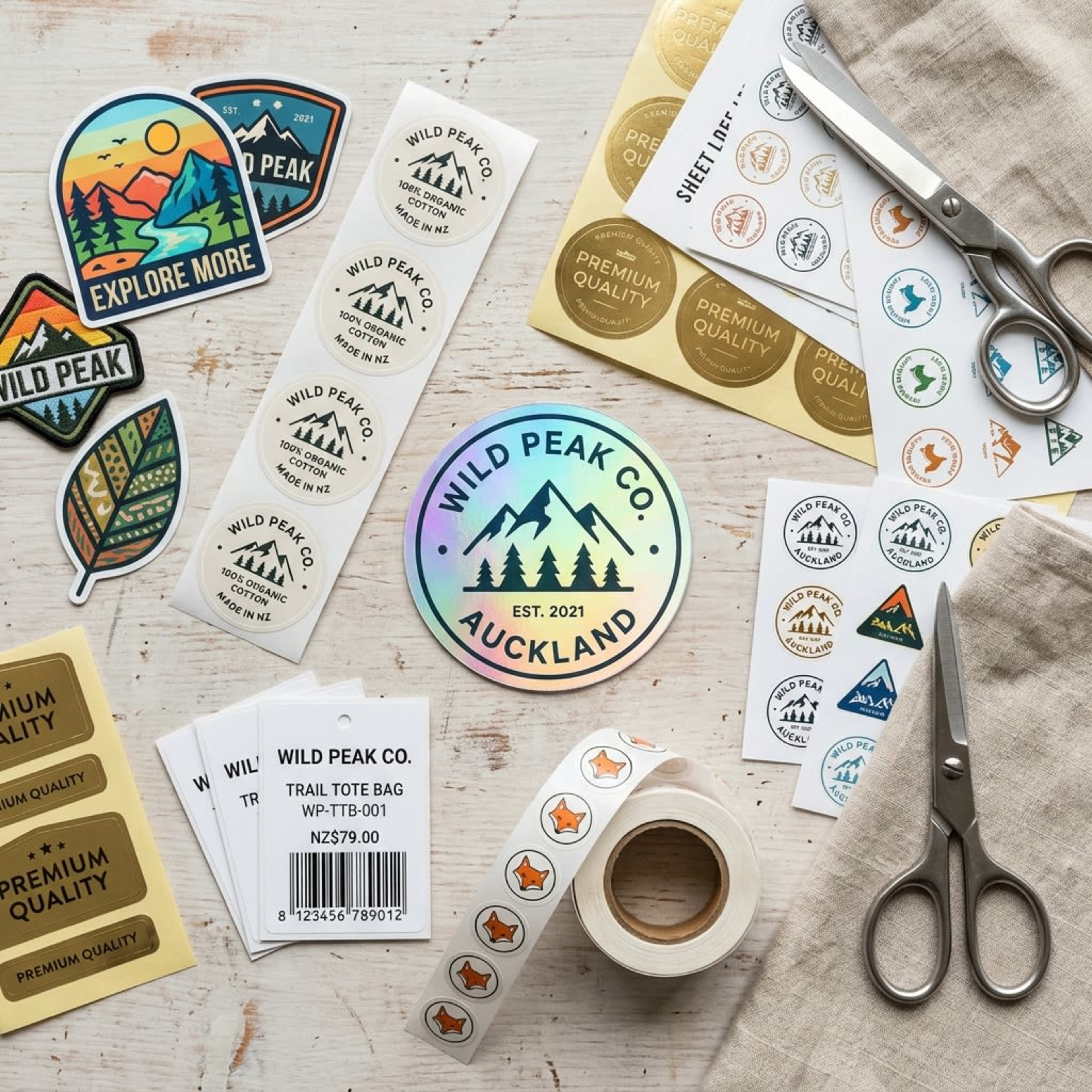
- Paper stickers remain one of the most economical options for businesses that require promotional stickers, product branding, event labels, or short-term packaging applications. They offer excellent print quality and are suitable for indoor use where exposure to moisture is limited.
- Vinyl stickers are widely preferred for their durability and weather resistance. They can withstand water, sunlight, and regular handling, making them suitable for outdoor branding, vehicle graphics, window displays, product packaging, promotional decals, and long-term applications.
- Transparent stickers create a clean and premium appearance by blending seamlessly with glass, plastic, acrylic, and transparent packaging. They are commonly used for cosmetic products, perfume bottles, beverage packaging, luxury products, and premium gift boxes where businesses want the product itself to remain visible.
- Die-cut stickers are customized according to the exact shape of a logo or design rather than being limited to standard circles or rectangles. These stickers provide a more creative appearance and are frequently used for branding, promotional merchandise, packaging inserts, and marketing campaigns.
- Waterproof stickers are specifically designed for products exposed to moisture, refrigeration, or outdoor conditions. Food containers, beverage bottles, cosmetic packaging, and bathroom products often require waterproof materials to ensure long-lasting performance.
Types of Labels and Their Applications
Labels are available in a wide variety of materials, finishes, and adhesive options, allowing businesses to choose solutions based on the type of product, packaging, and usage environment. Selecting the right label not only improves the appearance of a product but also ensures that important information remains clear and readable throughout its lifecycle.
One of the most commonly used options is the paper label. Paper labels are suitable for products that are stored in dry environments and do not require high resistance to water or harsh weather conditions. They are widely used for retail products, gift packaging, stationery items, bakery products, pharmaceutical cartons, promotional packaging, and office supplies. Since paper labels are economical and offer excellent print quality, they are often preferred for large-volume production where cost efficiency is important.
For products that require greater durability, vinyl labels provide an excellent solution. Vinyl material is resistant to water, oil, moisture, sunlight, and everyday wear, making it suitable for bottles, cosmetic containers, outdoor products, industrial equipment, chemical packaging, automotive products, and long-term branding applications. Businesses looking for labels that maintain their appearance under demanding conditions often choose vinyl because of its strength and flexibility.
Another popular option is the transparent label, which creates a clean and premium appearance by allowing the packaging itself to remain visible. Transparent labels are frequently used for glass bottles, perfume packaging, cosmetic containers, luxury products, beverages, candles, and premium food packaging where businesses want a minimal yet elegant presentation.
For businesses requiring high-quality product branding, metallic labels and foil labels add a premium touch. Gold, silver, and metallic finishes are commonly used for luxury packaging, gourmet food products, premium cosmetics, corporate gifts, wine bottles, and exclusive product collections. These labels enhance shelf appeal and create a more sophisticated brand image.
Businesses that require product identification often use barcode labels and QR code labels. These labels simplify inventory management, product tracking, warehousing, billing, and customer interaction. QR codes can also direct customers to websites, instruction manuals, warranty registration pages, promotional offers, or product information, creating a seamless connection between printed packaging and digital experiences. Shipping labels, warning labels, tamper-evident labels, security labels, asset labels, and inventory labels are also widely used across logistics, manufacturing, healthcare, education, and retail industries to improve organization and operational efficiency.
Choosing the Right Adhesive for Different Applications
The effectiveness of a sticker or label depends not only on the printed design but also on the adhesive used. Selecting the correct adhesive ensures that the label remains securely attached throughout storage, transportation, and customer use.
Permanent adhesive labels are designed to remain attached once applied. They are commonly used for product packaging, bottles, cosmetic containers, industrial products, food packaging, and retail merchandise where long-term durability is required.
Removable adhesive labels can be peeled away without leaving significant residue. These are ideal for temporary promotions, pricing labels, seasonal campaigns, exhibition displays, reusable containers, and products where labels need to be replaced regularly.
Some applications require high-tack adhesives that provide extra bonding strength for textured surfaces, corrugated boxes, plastic containers, metal products, or packaging exposed to moisture and temperature variations. Choosing the right adhesive improves reliability and reduces the risk of labels peeling during transportation or storage.
Popular Finishing Options for Sticker and Label Printing
Finishing options significantly influence the appearance, durability, and customer perception of printed stickers and labels. A suitable finish protects the print while enhancing the overall presentation of the product.
Matte lamination offers a smooth, non-reflective surface that creates a sophisticated and professional appearance. It is commonly selected for cosmetic labels, corporate branding, premium packaging, and products where readability is important.
Gloss lamination enhances colour vibrancy and provides a shiny surface that attracts attention. It is frequently used for food packaging, beverages, children's products, promotional stickers, and retail branding where bright colours improve shelf visibility.
For premium packaging, businesses often choose Soft Touch Lamination, which provides a luxurious velvet-like texture while protecting the printed surface from scratches and fingerprints. This finish is especially popular for luxury cosmetics, premium gift packaging, electronics, and high-end branding.
Businesses looking to highlight specific design elements may also choose finishing techniques such as Spot UV, Foil Stamping, Embossing, or Debossing. These finishes add texture and visual depth while creating a premium customer experience.
Design Tips for Effective Sticker and Label Printing
A professionally designed sticker or label should balance visual appeal with functionality. Attractive graphics alone are not enough if important information becomes difficult to read or the overall layout appears cluttered.
Businesses should begin by maintaining a clean layout that prioritizes readability. Product names, logos, and essential information should be clearly visible without overwhelming customers with excessive text. Proper spacing between design elements improves clarity while creating a more organized appearance.
Colour selection should remain consistent with the company's branding across all marketing materials. Using the same brand colours on packaging, business cards, brochures, catalogues, social media graphics, and labels strengthens brand recognition and creates a cohesive customer experience.
Typography is equally important. Decorative fonts may appear attractive, but they should never compromise readability. Clear font styles and appropriate font sizes ensure that customers can easily understand product information, ingredients, instructions, or safety warnings.
High-resolution artwork is essential for achieving sharp printing results. Low-quality images may appear acceptable on a computer screen but often lose clarity when printed. Businesses should always use professionally prepared artwork to ensure accurate colour reproduction and crisp image quality.
Maintaining adequate margins and bleed areas during the design process also helps prevent important content from being trimmed during production.
Common Mistakes Businesses Should Avoid
Many businesses focus primarily on attractive packaging while overlooking practical aspects of sticker and label printing. Avoiding common mistakes helps improve both presentation and functionality.
One of the biggest mistakes is selecting materials without considering the product environment. For example, paper labels may not perform well on refrigerated products or containers exposed to moisture. Choosing materials according to the intended application increases durability and customer satisfaction.
Another common issue is overcrowding labels with excessive information. While regulatory information may be necessary, presenting it in a well-organized layout improves readability without compromising aesthetics.
Poor colour selection can also reduce the effectiveness of packaging. Insufficient contrast between text and background may make important information difficult to read, particularly under retail lighting conditions.
Ignoring product shape is another frequent mistake. Labels designed for flat surfaces may not apply correctly to curved bottles, jars, tubes, or containers. Custom sizing and proper label dimensions help ensure smooth application and professional presentation.
Businesses should also carefully review artwork before printing. Spelling mistakes, incorrect product details, inaccurate barcodes, or outdated contact information can lead to unnecessary reprints and additional costs.
Choosing the Right Sticker or Label for Your Business
Every business has unique packaging and branding requirements, making it important to select sticker and label solutions that match specific products and marketing objectives.
A restaurant may require food-safe labels and takeaway packaging stickers, while a cosmetic brand may focus on premium waterproof labels with elegant finishes. An e-commerce business may prioritize barcode labels and shipping stickers, whereas a manufacturing company may need durable industrial labels capable of withstanding demanding environments.
Instead of selecting materials based solely on cost, businesses should evaluate durability, print quality, application surface, environmental conditions, branding requirements, and customer expectations. Investing in suitable sticker and label printing helps create packaging that looks professional, supports brand recognition, and enhances the overall customer experience.
At AdOn Print, businesses can choose from a variety of sticker and label printing options, including different materials, finishes, adhesive types, sizes, and custom shapes. This flexibility allows businesses to create packaging solutions that align with their branding while meeting practical product requirements.
Why Professional Sticker & Label Printing Matters for Your Brand
A sticker or label is often one of the first things a customer notices when picking up a product. Before reading about the features or experiencing the quality of the product itself, customers naturally observe the packaging, branding, colours, and presentation. This makes professionally printed stickers and labels an important part of building a positive first impression.
A professionally printed label does much more than display a logo or product name. It communicates essential product information, reflects the quality of your brand, improves shelf appeal, and helps customers identify your products quickly. Whether you are selling products in retail stores, supermarkets, exhibitions, online marketplaces, or through your own website, well-designed stickers and labels contribute to a more professional brand image.
Poor-quality printing can negatively affect customer perception. Faded colours, low-resolution graphics, peeling edges, poor adhesive quality, or unreadable text may reduce customer confidence even if the product inside is of excellent quality. Investing in quality printing helps businesses present their products more effectively while improving overall customer experience.
Another advantage of professional printing is consistency. When every product carries the same branding style, colours, typography, and design language, customers begin to recognize the brand more easily. Consistent branding strengthens brand recall and creates a professional identity across different product categories.
How Businesses Can Use Stickers and Labels More Effectively
Many businesses limit stickers and labels to displaying product names, but they can serve several additional purposes that improve both branding and customer engagement.
For example, QR code labels can direct customers to a product page, installation guide, instruction manual, warranty registration, promotional offer, or social media profile. This creates a seamless connection between physical packaging and digital communication without requiring additional printed materials.
Businesses can also use seasonal stickers during festivals, promotional campaigns, product launches, clearance sales, or limited-edition collections. Instead of redesigning the entire package, applying customized promotional stickers allows businesses to update packaging quickly and cost-effectively.
Tamper-evident labels improve customer confidence by indicating whether a product has been opened before purchase. These labels are commonly used for pharmaceuticals, cosmetics, food products, healthcare items, electronics, and premium consumer goods.
Personalized labels can also improve customer experience. Businesses that offer customized gifts, handmade products, bakery items, wedding favours, or corporate gift hampers often use personalized stickers featuring customer names, event branding, or custom messages to create a memorable unboxing experience.
Why Choose AdOn Print for Sticker and Label Printing
Choosing a printing partner involves more than simply comparing prices. Businesses often require consistent print quality, customization options, suitable material recommendations, and printing solutions that match their packaging requirements.
AdOn Print offers custom sticker and label printing for businesses across different industries. Customers can choose from a variety of paper and vinyl materials, transparent stickers, waterproof options, custom shapes, different adhesive types, and multiple finishing choices depending on the intended application.
Whether the requirement involves branding labels, product stickers, bottle labels, packaging labels, barcode labels, QR code stickers, promotional stickers, or custom business labels, businesses have the flexibility to select specifications that suit their products and marketing objectives.
Different size options, premium finishing, and customized printing allow businesses to create labels that complement their packaging while maintaining consistent brand identity across multiple product lines.
Instead of using a standard solution for every requirement, businesses can select printing specifications based on durability, appearance, application surface, and budget. This flexibility helps create packaging that not only looks professional but also performs reliably during storage, transportation, and customer use.
Frequently Asked Questions (FAQs)
Q1. What is the difference between a sticker and a label?
A sticker is generally used for branding, decoration, promotions, or marketing, while a label primarily provides product information such as ingredients, usage instructions, barcode details, manufacturing information, or pricing.
Q2. Which material is best for waterproof stickers?
Vinyl is one of the most commonly used materials for waterproof stickers because it offers good resistance to moisture, sunlight, and everyday wear.
Q3. Can stickers be printed in custom shapes?
Yes. Custom die-cut sticker printing allows businesses to create stickers in unique shapes based on logos, product outlines, branding elements, or creative designs.
Q4. Which industries use custom labels?
Food and beverage, cosmetics, healthcare, pharmaceuticals, retail, logistics, manufacturing, education, fashion, electronics, and e-commerce businesses all use custom labels for branding and product identification.
Q5. Are transparent labels suitable for premium packaging?
Yes. Transparent labels provide a clean and elegant appearance, making them a popular choice for cosmetic products, perfumes, beverages, candles, and luxury packaging.
Q6. Can QR codes and barcodes be printed on labels?
Yes. QR codes and barcodes are commonly printed on product labels to support inventory management, product tracking, customer information, and digital engagement.
Q7. Why are professionally printed labels important?
Professional printing improves colour accuracy, print clarity, durability, adhesive performance, and overall presentation, helping businesses create a stronger brand image and a better customer experience.
Conclusion
Sticker printing and label printing have become an essential part of modern business packaging and branding. From improving product presentation and strengthening brand recognition to communicating important product information, professionally printed stickers and labels support businesses across a wide range of industries.
Selecting the right material, adhesive, finish, and design ensures that packaging not only looks attractive but also performs effectively in real-world conditions. Whether you require paper stickers for promotional campaigns, waterproof labels for bottles, transparent labels for premium packaging, barcode labels for inventory management, or custom branding stickers for product packaging, choosing suitable printing specifications plays an important role in achieving long-term results.
As businesses continue to focus on customer experience and professional branding, high-quality sticker and label printing remains a valuable investment. Well-designed packaging creates trust, improves product visibility, and helps customers remember your brand long after the purchase has been made.
At AdOn Print, businesses can explore a wide range of custom sticker and label printing solutions with multiple material options, finishing choices, adhesive types, sizes, and customization features. Whether the requirement is for small quantities or large production runs, professionally printed stickers and labels can help create packaging that reflects your brand while supporting your business goals.