
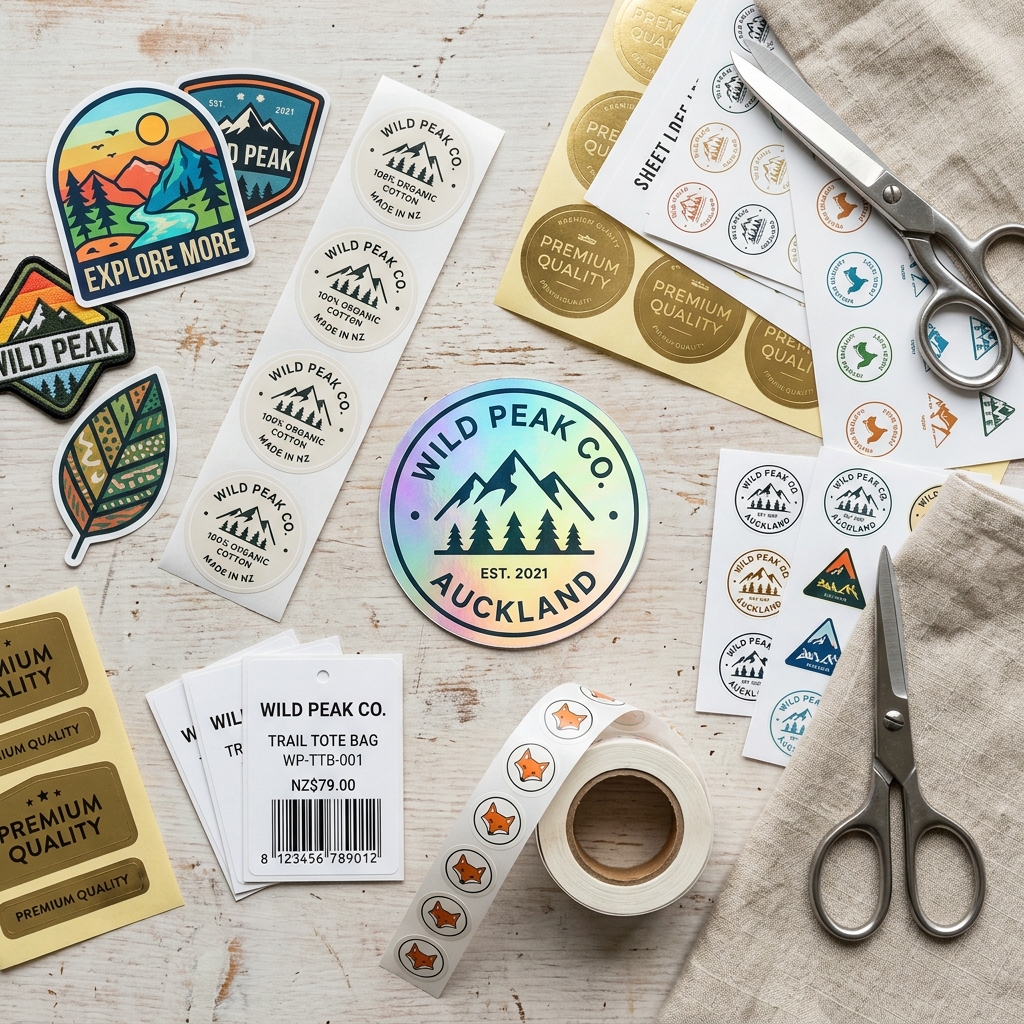
A sticker seems like the simplest thing in the world to get printed — until you actually try to order one for your business and realise there are about eight different finishes, four different adhesive types, and three different ways a printer can quote you a price depending on quantity and material. Most people searching for sticker printing near me end up on a website, get confused by the options, and either overpay for something they didn't need or end up with a sticker that peels off a bottle within a week.
I've seen this happen a lot with small D2C brands in Delhi — someone spends weeks perfecting their product, then treats the label as an afterthought, only to find out three months later that half their stickers have faded or peeled off in transit. The label is often the first thing a customer actually touches before they've even opened the product, so it's worth getting right the first time.
This guide covers what actually matters when you're ordering stickers or labels — for products, packaging, branding, or bulk distribution — and how to avoid the mistakes that show up only after the order has already shipped.
Why Sticker and Label Quality Affects Your Brand More Than You Think
A cracked, faded, or peeling label does something quietly damaging: it makes a good product look cheap. Customers rarely separate "this label looks bad" from "this brand feels unreliable," even if the product inside is genuinely excellent. This matters even more for categories where the sticker sits somewhere it gets handled a lot or exposed to moisture — spice jars, cosmetic bottles, water bottles, dry fruit packaging, and anything shipped through courier where a package gets tossed around before it reaches the customer.
On the flip side, a sticker that feels slightly glossy, doesn't scuff at the edges, and stays firmly stuck after a few weeks in a bag or fridge quietly reinforces the idea that the product itself is well made. It's a small, cheap detail that does a surprising amount of work for brand perception.
Understanding the Different Types of Stickers and Labels
Before ordering, it helps to actually know what you're choosing between, because the terminology gets thrown around loosely by a lot of printers.
- • Vinyl stickers are the most durable, everyday option — waterproof, tear-resistant, and able to handle outdoor exposure without fading quickly. These are the go-to for product labels that might get wet, get handled roughly, or need to survive a few months of shelf life.
- • Matte stickers give a soft, non-reflective finish that works well for brands going for a minimal, understated look — common with skincare, wellness, and boutique food brands where the design already carries enough visual weight without a shiny finish competing for attention.
- • Holographic stickers shift colour depending on the angle of light, and are mostly used for premium packaging, limited editions, or anti-counterfeit branding where a brand wants a sticker that's difficult to replicate cheaply.
- • Transparent (clear) stickers print only where the design is, with the rest of the sticker staying invisible against the surface underneath. These are popular for glass jars, premium cosmetic packaging, and any product where the container itself is part of the aesthetic and shouldn't be covered by a solid background.
- • Waterproof stickers are specifically engineered to survive moisture, condensation, and repeated handling — essential for anything going into a fridge, bathroom, or kitchen, and non-negotiable for water bottle labels or food packaging that might get splashed.
- • Kraft/paper stickers give a natural, earthy look that's become popular with organic food brands, dry fruit packaging, and eco-conscious labelling, though they're less resistant to moisture unless laminated.
- • Die-cut stickers are cut precisely along the shape of the design itself rather than staying in a plain rectangle or circle — used heavily for logo stickers, product branding, and anything meant to look intentional rather than mass-produced.
Adhesive Type Matters More Than Most People Realise
This is the part almost nobody asks about until a batch of stickers starts falling off. Permanent adhesive is the standard choice for product labelling — once applied, it's meant to stay for the life of the product. Removable adhesive is used for things like promotional stickers, price tags, or temporary labelling where you expect the sticker to come off cleanly later without leaving residue.
If your product is going to be stored in a fridge or freezer, ask specifically whether the adhesive is rated for cold-surface application — a standard adhesive that works fine at room temperature can lose its grip in cold, humid conditions, which is exactly why so many spice jar and frozen food labels fail after a few weeks if the wrong adhesive was used.
Common Sticker Categories by Business Type
- • FMCG and food brands typically need waterproof or laminated vinyl stickers that can survive handling, refrigeration, and repeated wiping. Ingredient and nutritional information needs to stay legible, so matte finishes with high-contrast printing tend to work better than glossy ones that can catch glare under store lighting.
- • Cosmetic and skincare brands often go for a mix of matte or transparent stickers with fine typography, since this category leans heavily on the label looking premium rather than purely functional.
- • E-commerce sellers usually need two categories at once — branded product stickers and shipping/packaging stickers (fragile labels, thank-you stickers, tape seals). These don't need to be expensive, but they do need to survive transit without smudging.
- • Jewellery and accessories brands tend to use smaller, precisely die-cut stickers or tags, often in kraft or gold-foil finishes, since the sticker itself becomes part of the unboxing presentation.
- • Spice, dry fruit, and pooja item packaging needs stickers that can handle grease, moisture, and repeated handling in a kitchen environment — this is one of the categories where cutting corners on adhesive quality shows up fastest.
- • Manufacturers and industrial suppliers generally need barcode labels, warning/fragile stickers, and manufacturer labels printed in bulk, where legibility and scan-ability of barcodes matter more than visual design.
What to Check Before Placing a Bulk Sticker Order
-
1
Ask for a physical sample before committing to a large quantity. A sticker looks different on a screen than it does printed and stuck onto your actual product surface — glass, plastic, and cardboard all interact differently with the same adhesive and finish.
-
2
Confirm the minimum order quantity and price break points. Sticker pricing usually drops significantly at higher volumes, so it's worth asking what the per-unit cost looks like at 500, 1000, and 5000 units before deciding on a quantity — sometimes ordering slightly more costs almost the same as ordering less.
-
3
Check the actual print resolution being used, especially if your design has fine text or a detailed logo. Cheap bulk sticker printing sometimes uses lower-resolution output that looks fine at a glance but turns small text blurry once printed at actual size.
-
4
Ask whether the sticker is laminated or unlaminated. Lamination adds a protective layer over the print that resists scratches, moisture, and fading — without it, a sticker exposed to sunlight or handling can visibly fade within weeks.
-
5
Clarify turnaround time for your actual quantity, not just the advertised minimum. A 500-unit order and a 10,000-unit order don't take the same time to produce, and a website that only advertises "same-day dispatch" without specifying quantity limits can lead to unrealistic expectations.
-
6
Ask about die-cutting accuracy if you're ordering a custom shape. A slightly inaccurate die-cut can leave a visible white edge around your design, which becomes obvious the moment the sticker is applied.
Digital Printing vs. Offset Printing for Stickers
This is another detail that rarely gets explained clearly, and it changes both cost and quality depending on your order size. Digital printing is more cost-effective for smaller batches and allows for quick turnaround, since there's no need to set up printing plates — this makes it the better choice for a business testing a new product design or ordering a few hundred stickers at a time. Offset printing, on the other hand, becomes more economical at very high volumes (typically several thousand units and above), since the per-unit cost drops significantly once the initial plate setup cost is spread across a larger run.
For most small and mid-sized businesses in Delhi ordering stickers in the low thousands, digital printing tends to be the practical choice — the quality difference at that scale is minimal, and the flexibility to reorder in smaller batches without committing to a huge volume upfront is usually worth more than the marginal per-unit savings offset printing would offer.
Mistakes That Show Up Only After the Stickers Are Already Applied
A few issues are almost impossible to catch by looking at a digital proof on screen, and only become obvious once the sticker is physically stuck onto the product:
- • Colour shift between screen and print. RGB colours on a monitor don't always translate exactly to CMYK ink on paper or vinyl, so a bright blue on screen might print slightly duller or shift toward purple. Asking for a physical proof before a large run catches this before it becomes a 5,000-unit problem.
- • Adhesive residue on removal. If a sticker ever needs to be removed or repositioned — common with promotional or seasonal labels — a low-quality adhesive can leave a sticky residue behind that's harder to clean than the sticker was to apply. This is worth testing on the actual surface material beforehand, not assumed.
- • Print rubbing off with handling. Unlaminated prints, especially with darker inks on lighter backgrounds, can show visible wear from repeated handling within just a few weeks. This is one of the clearest signs that lamination was skipped to save on cost.
- • Barcode scan failures. For manufacturer and FMCG labels using barcodes, low print resolution or poor contrast can cause scanning failures at checkout counters — something that's easy to overlook during design approval but becomes a real operational problem once products are on shelves.
- • Size mismatch with the container. A sticker designed without measuring the actual product surface can end up slightly too large or too small, wrapping awkwardly around a curved bottle or leaving unwanted gaps. Sending exact container dimensions to the printer before finalising the design avoids this entirely.
Why Ordering from a Delhi-Based Manufacturer Makes Sense for Bulk Orders
Sticker and label orders are almost always recurring — once a brand finalises its packaging, it reorders the same stickers every few months as stock runs low. This makes turnaround time and consistency across batches more important than a one-time low price.
A Delhi NCR-based manufacturer that prints in-house, rather than routing your order through a third-party press, offers two real advantages here. First, colour consistency across reorders tends to be tighter, since the same press and the same calibration are used each time rather than whichever press happens to have capacity that week. Second, express or same-day dispatch is realistic for businesses based in Delhi, Noida, Gurgaon, or Ghaziabad, which matters a lot when a business realises they're about to run out of packaging labels mid-week and can't wait for a shipment from another state.
A Rough Guide to Sticker Pricing
Sticker pricing depends heavily on material, finish, and size, but as a general pattern in the Delhi market:
- • Standard vinyl or matte stickers at smaller sizes sit at the more affordable end, especially at higher order volumes.
- • Waterproof and laminated stickers cost slightly more due to the additional lamination step, but this is rarely worth skipping for anything product-facing.
- • Holographic, transparent, and specialty finishes sit at the premium end, since these require different base material and printing processes.
- • Die-cut custom shapes typically cost a bit more per unit than standard rectangular or circular stickers, due to the additional cutting die required.
As with most printing categories, the price difference between a basic sticker and a properly waterproof, laminated one is usually small relative to the overall packaging cost — and it's the difference between a label that survives the product's shelf life and one that needs to be reprinted and reapplied after complaints start coming in.
Frequently Asked Questions
What's the difference between a sticker and a label?
In practice, the terms are used almost interchangeably, but "label" usually implies something applied directly to a product for identification (ingredients, barcodes, branding), while "sticker" often includes decorative or promotional use as well. The printing process is largely the same either way.
Do waterproof stickers cost significantly more than regular ones?
The cost difference is usually modest, and worth it for anything that will be handled, refrigerated, or exposed to moisture — the cost of reprinting a batch that failed early is far higher than the small premium for waterproof material upfront.
What's the minimum order quantity for custom stickers?
Most Delhi printing presses print stickers starting from small batches for testing, with pricing dropping meaningfully as quantity increases into the hundreds or thousands.
Can I get a sticker sample before placing a full bulk order?
Reputable manufacturers should be able to provide a physical proof or small sample batch before you commit to a large print run, especially for a new product launch.
How long do vinyl stickers typically last outdoors or in humid conditions?
Good-quality laminated vinyl stickers can hold up for a year or more even with regular handling and moisture exposure, while unlaminated or lower-grade stickers may start fading or peeling within a few months.
Final Thoughts
Stickers and labels don't get the same design attention that packaging or visiting cards do, but they're often the part of a product that a customer physically interacts with the most — peeling it, reading it, checking if it's still stuck after a few weeks in the fridge. Getting the material, adhesive, and finish right the first time saves a business from the much bigger cost of reprinting an entire batch after complaints start rolling in.
If you're ordering in bulk and need consistency across repeat orders along with genuinely fast turnaround in Delhi NCR, working directly with a manufacturer that prints in-house is usually the more reliable choice over a marketplace that outsources your order to whichever press has capacity that week.
Explore Sticker & Label Options & Place Order
Custom die-cut, waterproof vinyl, transparent, matte & barcode stickers with express same-day dispatch across Delhi NCR.